
Menu
Crown and Bridge Treatment
in Nagpur: Dental Crowns
and Bridges Specialist
Choosing the right crown and bridge treatment is essential for restoring
both your smile and your chewing ability in 2026.
What Are Dental Crowns and How Do They Restore Crown and Bridge Teeth?
Dental crown: a cap that covers and protects a damaged tooth (after root canal, fracture, or large filling).
Crowns restore shape, strength, and appearance.
Materials: full metal, porcelain-fused-to-metal (PFM), full ceramic/zirconia, or resin temporaries.
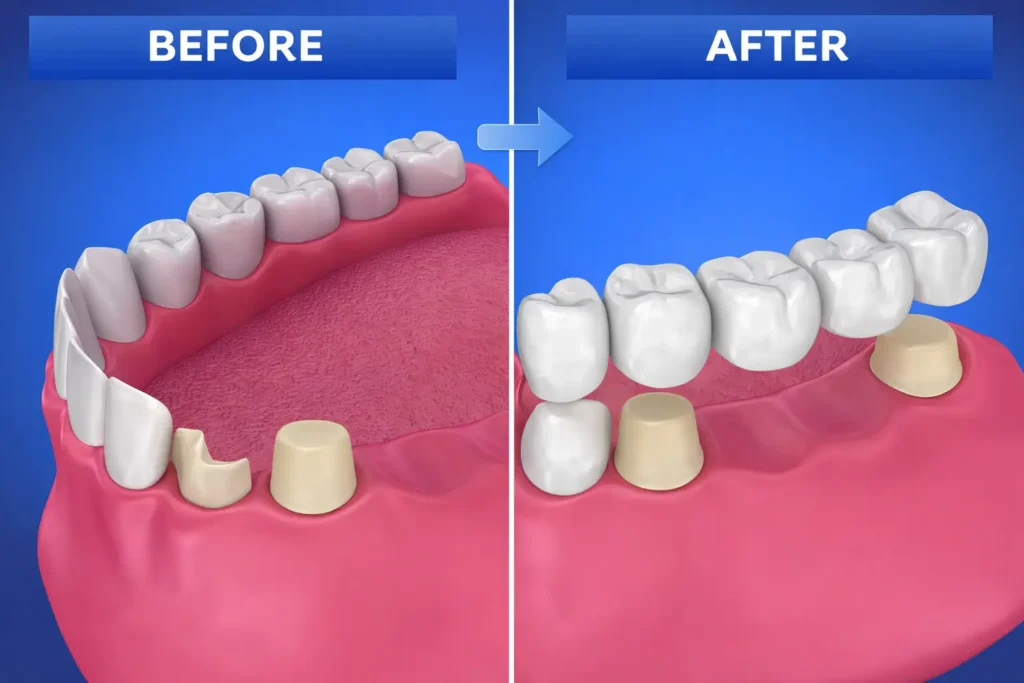
Role in crown and bridge treatment: Crowns act as abutments (anchors) for fixed bridges that replace one or more missing teeth; crowns also protect weakened teeth on their own. The IDA describes fixed bridges as pontics supported by neighboring crowned abutments.
What Is a Dental Bridge and How Does It Replace Missing Teeth?
Dental bridge: a fixed prosthesis with a false tooth (pontic) joined to crowns on adjacent natural teeth or implants.
Types: conventional fixed bridge, cantilever bridge, resin-bonded (Maryland) bridge, and implant-supported bridge.
When used: to close gaps, restore chewing, maintain tooth alignment, and preserve facial form. IDA guidance outlines bridge options and indications following clinical and radiographic evaluation.
Who Needs Crown and Bridge Treatment?
You may be an ideal candidate for crown and bridge treatment if you have a tooth that is fractured, severely discolored, or heavily worn down. Patients missing a single tooth or a row of teeth also benefit from this restoration to restore speech and chewing function. At our clinic, we assess your gum health and bone structure to ensure your mouth can support these permanent fixtures.
A broken or heavily restored tooth that needs protection.
One or more missing teeth with healthy adjacent teeth to support a bridge.
Functional or aesthetic problems from missing teeth.
Sufficient bone and gum health; otherwise, preliminary periodontal treatment or implant options may be recommended.
Step-by-Step Procedure for Crown and Bridge Treatment
The process at our Nagpur clinic typically requires multiple refined steps for optimal results:
1. Preparation
Your dentist numbs the area with local anesthesia and reshapes the natural tooth to make room for the crown.
2. Impressions
We take a digital or physical mold of your teeth, which is sent to a high-tech lab for custom fabrication.
3. Temporary Phase
A temporary crown is placed to protect your tooth while your final restoration is being crafted.
4. Final Fitting
Once your custom dental crowns and bridges are ready, we check the fit, color, and bite before permanently bonding them into place.
Why Crown and Bridge Treatment in Nagpur Is Often Better Than Alternatives
Unlike removable dentures, dental crowns and bridges are fixed prosthetics that feel and function like natural teeth. They offer more stability, meaning you don’t have to worry about them slipping or wiggling while eating or talking. While implants are a great option, a bridge is often a faster, less invasive solution for many patients in Nagpur looking to restore their bite quickly.
Key Benefits of Dental Crowns and Bridges
Restore chewing and speech — regain full function for daily life.
Protect weakened teeth — crowns prevent further fracture after RCT or large fillings.
Replace missing teeth — bridges close gaps, preventing drift and bite problems.
Aesthetic improvement — natural-looking restorations enhance smiles.
Predictable longevity — most crowns and bridges demonstrate high survival at 5 years and beyond in clinical studies. Systematic reviews report survival rates generally above 85–95% at five years for crowns and many bridges, with variability by design and material.
Why Choose Our Crowns and Bridges Speciality Dental Clinic
Our crowns and bridges speciality dental clinic in Nagpur combines 15+ years of clinical expertise with modern diagnostic tools. We prioritize patient comfort and use only high-grade materials like Zirconia for long-lasting results. We ensure every crown and bridge treatment is tailored to your unique facial structure, providing a seamless and functional restoration
Specialised prosthodontic care: trained clinicians experienced in crown and bridge teeth restorations.
Patient-centred planning: clear explanations, digital imaging (CBCT/scans) and customised treatment plans.
Modern materials & lab partnerships: zirconia and high-strength ceramics for durable esthetics.
Sterile workflows & IDA-aligned protocols: we follow professional standards for safe, predictable care.
Transparent pricing & timelines: itemised estimates, clear options (crown vs bridge vs implant) and 2026-upgraded digital workflows for faster turnaround.
Do’s and Don’ts After Crown & Bridge Treatment
Proper aftercare helps your restoration last longer and prevents complications.
Do
- Maintain good oral hygiene: brush twice daily and floss around the restoration.
- Use interdental brushes or floss threaders for bridges.
- Attend regular dental checkups every 6–12 months.
- Wear a nightguard if you grind your teeth.
Don’t
- Bite very hard items (ice, hard candy) with the restored tooth.
- Delay follow-up if you feel looseness, pain, or persistent sensitivity.
- Ignore gum bleeding or recession near the restoration.
Following these aftercare practices improves restoration longevity and reduces complications.
Book Your Crown and Bridge Consultation Today
If you are experiencing broken, weak, or missing teeth, crown and bridge treatment can restore your comfort, function, and confidence. Early treatment helps prevent further damage and more complex procedures later.
At Dr. Nikshi’s Orthodontic Centre and Dental Implant Clinic, Nagpur, every treatment plan begins with a detailed consultation and clear explanation of your options. You will receive an itemised estimate, digital evaluation, and honest guidance—so you can make an informed decision.
Take the next step toward a healthier smile.
EXCELLENTTrustindex verifies that the original source of the review is Google. Orthodontic treatment for my daughter started by Dr. KamblePosted on GoogleTrustindex verifies that the original source of the review is Google. Teeth alignment done from Dr. Nikshi.Posted on GoogleTrustindex verifies that the original source of the review is Google. Braces. Treatment of. my daughter done by Dr. NikshiPosted on GoogleTrustindex verifies that the original source of the review is Google. Started metal braces treatment from Dr. NikshiPosted on GoogleTrustindex verifies that the original source of the review is Google. Started my braces journey from Dr. Nikshi. Nice experience.Posted on GoogleTrustindex verifies that the original source of the review is Google. Thank you sir for flawlessly performing a complex dental treatment. Highly recommended.Posted on GoogleTrustindex verifies that the original source of the review is Google. Mi sirankade last year 1st time aali hoti. Majya eka danta la keed lagli hoti Ani pus pan ala hota. Sirani maji pus ani daad kadhun takli karan ki te khup kharab jaali hoti. Ani dusrya dantala root canal karun tyala vachawla. Mi gavi hoti tar eka dusrya dr. Kade dusra dant kadla but te ata pan dukhat aahe .mag mi parat dr.nikshi kade ale ani sirani mala pain free treatment kela ani ek implant pan takun dila.Posted on GoogleTrustindex verifies that the original source of the review is Google. I went to this doctor for a dental cap, and it turned out to be a big mistake. The cap was wrong and it completely messed up my bite. I was in constant pain and even started getting headaches because of it. Instead of fixing the problem, the doctor ignored my complaints and never changed the cap. My teeth condition actually got worse after the treatment. I suffered for a long time and finally had to go to another dentist to get it corrected. This experience was extremely stressful. I am sharing this review so that other patients are aware and take a second opinion before getting treatment here..worst treatment...worst doctor...awful knowledge...just basic things he can do...don't go here plz.Posted on GoogleTrustindex verifies that the original source of the review is Google. Braces treatment done by Dr. Nikshi.Posted on GoogleTrustindex verifies that the original source of the review is Google. I visited Dr.Nikshi's Clinic for my TMJ (jaw joint) problem, which was causing pain and discomfort for a long time. The doctor explained the cause in a very clear and simple way and guided me properly about treatment and precautions. I felt comfortable and confident during the consultation. I am happy with the treatment and would definitely recommend this dentist to anyone facing TMJ issues.
FAQ's For Crown And Bridge Treatment in Nagpur
Clinical literature shows most crowns survive at least five years with good function; many last 10–15 years or longer depending on material, design, and oral hygiene. Bridges show high 5-year survival (often >85–90%), but complications such as debonding and chipping can occur.
Individual factors — bruxism, periodontal health, and maintenance — strongly influence longevity. Regular dental reviews and addressing risk factors (decay, gum disease) help extend the lifespan of crowns and bridges.
Most patients report minimal discomfort because tooth preparation and bridge procedures are performed under local anaesthesia. Temporary sensitivity after preparation is common but typically resolves within days.
Pain control and topical or local anaesthesia protocols are standard; sedation options can be discussed for anxious patients. Proper technique and infection control reduce complications and post-op pain. If severe pain or swelling occurs after treatment, contact your dentist promptly.
Costs vary by material and complexity. In India, crown prices typically range from low-cost metal crowns up to premium full-ceramic or zirconia crowns; bridges add the cost of additional crowns and lab work.
Exact pricing depends on material choice (PFM vs zirconia), number of units, and whether additional procedures (core build-up, RCT, or periodontal work) are needed. We provide itemised estimates after exam and radiographs so you can compare options transparently. (Local clinic price snapshots and IDA guidance inform typical ranges.)
Yes — a fixed bridge is a proven option to replace one or more adjacent missing teeth when neighboring teeth are healthy enough to serve as abutments. Bridges are less invasive surgically than implants and often have faster timelines.
However, bridges require preparation of adjacent teeth and do not prevent bone loss at the extraction site. If bone preservation is a priority or adjacent teeth are healthy and untouched, implant solutions may be preferable. Clinical evaluation will determine the best approach.
You can usually eat soft foods the same day, avoiding very hard or sticky foods for about 24–48 hours to allow cement to set and tissues to settle. If a temporary crown or bridge was placed, avoid chewing directly on that side until the final restoration is cemented.
Your dentist will give specific dietary guidance based on the restoration type and cement used. If you experience persistent discomfort while chewing, contact the clinic.
Bridges need the same daily oral care as crowns, plus special attention to cleaning under the pontic (using floss threaders or interdental brushes).
Regular professional cleanings and periodontal checks help prevent decay at abutment teeth and gum disease around the bridge. Timely repair of minor issues (chip, debonding) is easier if detected early. Maintenance directly affects bridge lifespan and overall oral health.